
Bright Ray / Your home, considered

Battery storage for a home solar system

A battery is a separate decision from the solar panels. This guide helps you think about when your household uses electricity, what capacity and compatibility mean, where a battery could go and what to ask a provider.

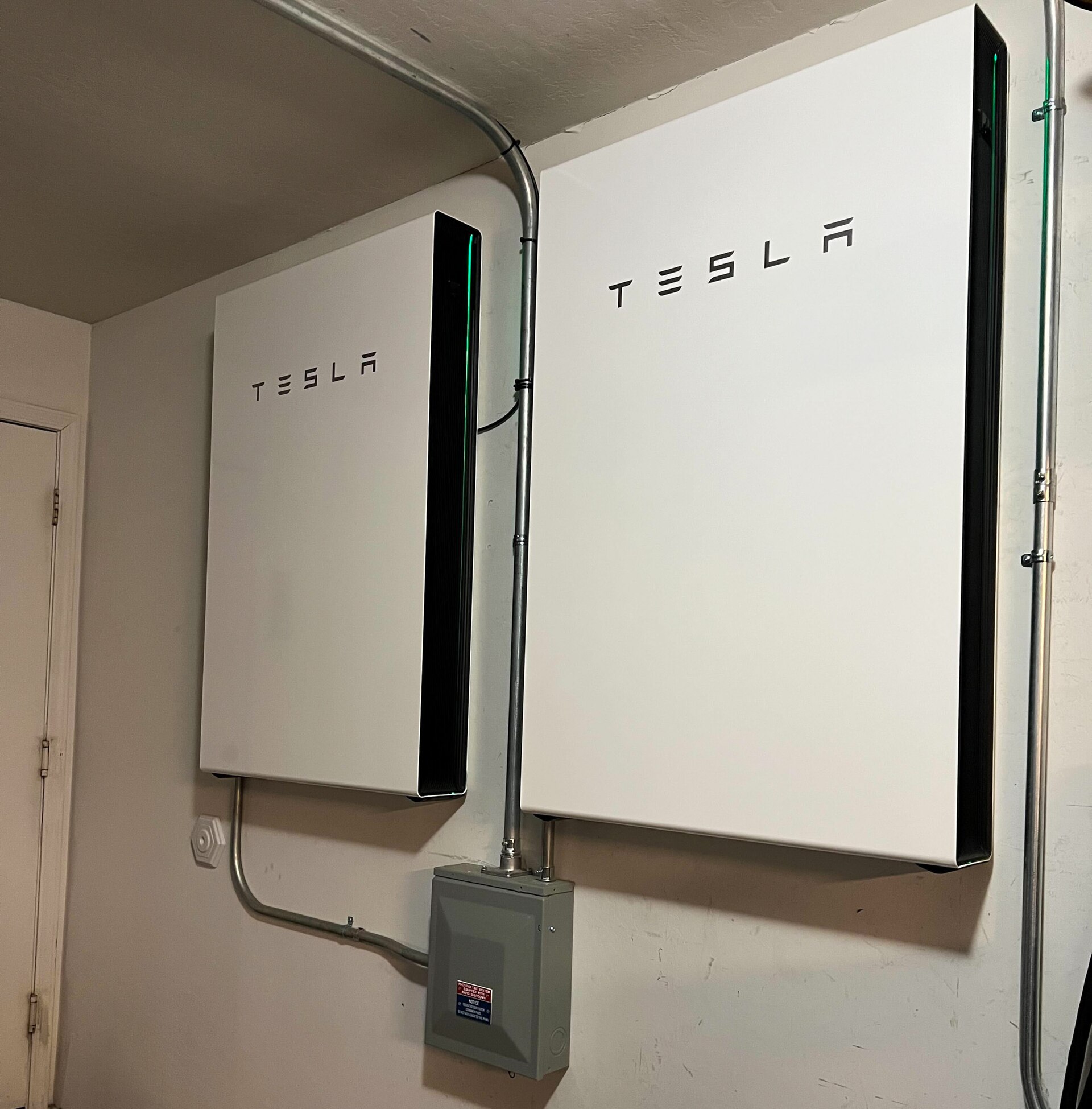
Two wall-mounted Tesla home batteries; illustrative equipment example.

When does your household use electricity?

Choose the closest pattern

I use most of my electricity in the daytime

If someone is usually at home, more of the solar electricity may be used as it is generated, so a battery may have less to store. It is still worth checking your actual usage.

How much of my use already falls while the panels are producing?

I use most of my electricity in the evening

Generation peaks in daylight, so a battery is the way to hold some of it for later. The size of battery that suits you depends on your evening use and the space available.

How much evening use could a battery realistically cover?

My use is spread across the day or varies

Patterns that change with the seasons, shifts or working from home are hard to judge by feel. Looking at real usage figures first makes the battery question easier to answer.

Can we review my actual usage before deciding on a battery?

Nominal capacity
The total energy the battery is rated to hold, in kilowatt-hours. It is the figure usually quoted first, but not all of it can be used.
Usable capacity
The portion of the stored energy you can actually draw on. Ask for this figure alongside the nominal one.
Power and energy
Energy, in kWh, is how much is stored. Power, in kW, is how quickly it can be delivered, which affects how many appliances it can run together.
Inverter compatibility
Whether the battery can connect to your inverter or needs its own. Check this before buying either, especially if you plan to add a battery later.

Do you need a battery?

Solar panels work without a battery. A battery only matters if you want to use more of your own generated electricity at times when the panels are not producing, such as in the evening.

Choose the pattern below that sounds most like your household to see what it could mean for the decision.

Home during the day

If much of your use already falls in daylight hours, a battery may add less than you expect.

How much of my electricity do I use between morning and late afternoon?

Busy in the evening

If most use is after work and school, a battery is the way stored daytime generation could be used later.

How much do I use after dark, and what would a battery cover?

Mixed pattern

Use may vary through the week and the seasons. Your own meter readings are a better guide than a guess.

Can I look at my actual half-hourly or daily usage first?

Capacity and compatibility explained

Battery figures can be confusing because the same product may be described in several ways. Ask for each figure to be explained in writing.

Compatibility matters because the battery has to work with the inverter and the rest of the system, and not every combination does.

Nominal capacity

The headline figure, in kilowatt-hours, for the total energy the battery is built to hold.

What is the nominal capacity?

Usable capacity

The part of the capacity you can actually draw on. It is often lower than the nominal figure.

What is the usable capacity?

Power and energy

Energy (kWh) is how much is stored. Power (kW) is how fast it can be delivered, which limits what can run at once.

What is the maximum power output, as well as the capacity?

Inverter link

The battery connects through or alongside the inverter. A system may be designed for later addition or fitted together.

Will my inverter work with this battery?

Where could a battery go?

Batteries are heavy and need a suitable location. Garages and utility spaces are common, but the right place depends on the product and the property.

Siting, ventilation and fire safety are questions for a competent provider to assess and answer for your home. Do not assume any space is suitable.

Garage or utility room

Often convenient for cable routes, but check temperature range, damp and whether the space is shared.

Is my chosen space suitable for this battery?

Access and weight

Think about getting the unit in, the wall or floor fixing needed and later access for service or removal.

What fixing and access does the unit need?

Ventilation and clearances

The manufacturer may specify clear space around the unit and limits on what can be stored near it.

What clearances and ventilation are required?

Fire safety

Ask how the proposed location relates to escape routes, doors and the rest of the house.

How has fire safety been considered for this location?

What to ask a battery provider

A battery is a long-term purchase, so the terms around it matter as much as the headline figures. Put these questions in writing and keep the answers.

Warranty terms

Ask how long it lasts, what is covered, and whether the warranty depends on usage limits or a stated number of cycles.

What exactly does the warranty cover and for how long?

Degradation

Capacity gradually falls with use. Ask what level the maker expects it to reach by the end of the warranty.

What capacity should remain at the end of the warranty?

Backup behaviour

Many batteries do not power the home during a grid outage unless specifically designed and wired to. Ask directly.

Will this battery power anything if the grid goes down?

Monitoring

Check what you can see about charging, discharging and stored energy, and whether it needs an internet connection.

What does the monitoring show me about the battery?

End of life

Ask who is responsible for removal and recycling when the battery reaches the end of its working life.

What happens to the battery at the end of its life?

Start with one email

Ask whether storage is part of what we do

Not every provider fits every battery request. Tell us about your home and your questions, and we will say plainly whether storage is something Bright Ray can help with.

Illustrative home comfort concept; not a real location or a Bright Ray project.
Illustrative home concept